

Hackathon STATEC 2025 – Ageing Luxembourg
What is the Hackathon?
In October 2025, STATEC, Luxembourg’s national statistics office, organized the Hackathon in partnership with the GovTech Lab: a 3-day event during which teams of 4 to 6 volunteers had to address a topic announced on the first day.
The teams were given complete freedom regarding their final outputs, as long as they met certain objectives assessed through transparent criteria communicated during the initial presentation. The objective was therefore to develop a dashboard based on public data, presenting the effects of the ageing of the Luxembourgish population on society and the economy.
The evaluation criteria allowing for a fair and equitable assessment were then defined as follows:
- Relevance: Does the dashboard present the topic in a useful way?
- Use of data: Are the sources provided used effectively and combined in a way that creates new insights?
- Innovation: Is the dashboard creative and does it present an innovative analysis / approach?
- Reproducibility: Can the final outputs (code, documentation) be easily reproduced?
- Robustness: Does the dashboard operate reliably?
- Presentation: Were the results communicated effectively?
Who represented Artemis?
The team of volunteers representing Artemis was composed of 5 experts:
- Kevin Alati: Data tech lead / Data scientist
- Christophe Boutron: IT Expert / System and network administrator
- Sandrine Herbeth: Project Manager / Business Development Manager
- Mathieu Scheffer: Data scientist
- Quentin Schmidt: Economist / Data scientist
The creation of this team brought together a broad range of skills, from IT development to more transversal skills such as economics, as well as data analysis, data science, and data management.
Key points of the result
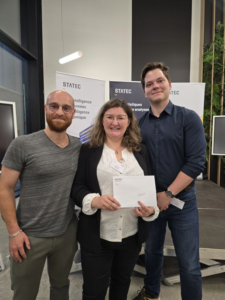
Thanks to the team’s multidisciplinary skills (due to the fact that Artemis is involved both in evaluation and in official data); the mixed approach was a success, allowing Artemis to win 4th place, a victory given that it received more or less the same prize as the 3rd-place team, and given that it ranked highest among the private companies that participated. All the other teams were composed of academics / researchers linked to public organizations.
The approach was based on a mixed approach relying on 2 of Artemis’s 3 dimensions, its experience in evaluation and its experience with official data:
Summary
A simplified evaluation matrix
In evaluation, an evaluation matrix is a tool designed to transparently and structurally present how to answer an evaluative question. Given the nature of the question, which may be considered a public policy or public action, the use of an evaluation methodology is relevant.
The matrix therefore presents the team’s thought process in a transparent and reproducible way. The objective is also to avoid as much as possible potential biases directing the answers in one direction or another.
The matrix normally guides the evaluation in its entirety. Due to the relatively short duration of the event, the matrix used was significantly simplified compared with the matrices normally used.
A dashboard for public debate
Public debates increasingly put forward arguments to prove a point, but often without specifying the indicators / sources / methodologies used. This is why the dashboard had a specific objective: to allow Luxembourg citizens to quickly and effectively learn about the topic of ageing, as well as its impacts on Luxembourgish society and the economy. The main topics of concern were therefore presented in this dashboard, subsequently allowing STATEC to take a leading role in the public debate, presenting itself as THE reference.
The intended consequence was therefore to clarify debates with precise and sourced data, but also freely accessible on the STATEC website. Luxembourg citizens could thus form an opinion based on facts, rather than biases or opinions.
Strengths
Full transparency regarding the data and methodology used
Perfect reproducibility of the results
A simple and interactive design
Clarity in the information presented
Reliability and trust in the tools
Open-source data, software, and packages
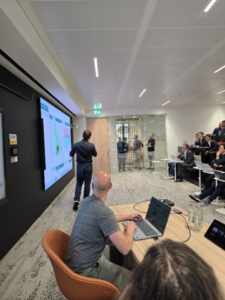
The presentation itself was given before a panel composed of STATEC unit managers as well as its current president: Tom HASS.